

Losing a limb changes everything in a split second. Suddenly, the most basic tasks—holding a child’s hand, zipping up a coat, or using a fork—become daily frustrations.
For many, an artificial arm is the only way to bridge the gap between a life of struggle and a life of autonomy. It isn’t just about the mechanics; it’s about a person feeling whole again.
Today, we are seeing a massive shift in how people view disability. It is no longer about what someone is missing, but what they can achieve with the right tools.
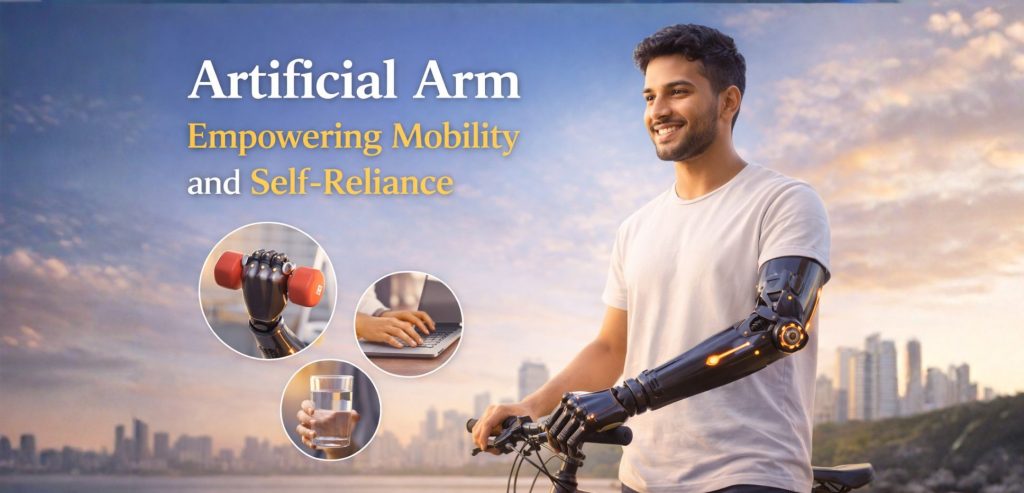
Whether it is a basic mechanical device or a high-tech bionic hand, the goal of every artificial arm is to give a human being their dignity back.
The Hard Reality of Living Without a Limb
When we talk about the need for an artificial arm, we have to look at the sheer scale of the problem. Millions of people are currently waiting for a chance to move freely again.
-
A Global Gap: Statistics from the World Health Organization (WHO) show that roughly 35 to 40 million people worldwide need prosthetic help. The sad truth? Only about 1 in 10 actually has access to the device they need (Source: WHO Assistive Technology Report).
-
The Financial Wall: Getting a functional artificial arm is expensive. A basic model can start at $5,000, but for those who need advanced sensors or bionic fingers, the cost can easily hit $50,000 to $100,000 (Source: Orthotics Ltd, 2025).
How Modern Artificial Arms and Hands Work
Every person’s body is different, so every artificial arm must be tailored to the individual. Choosing between different artificial arms and hands usually comes down to what the user needs to do every day—whether that’s manual labor or office work.
There are three main ways these devices work today:
-
Body-Powered: These use a harness and a cable. When you move your shoulders, it pulls the cable to open or close the hand. It’s tough, reliable, and doesn’t need batteries.
-
Myoelectric: These use sensors on the skin. They pick up the tiny electrical signals your muscles make and turn them into smooth, motorized movements.
-
Passive: These are designed to look as real as possible. While they don’t move as much, they provide an incredible boost to a person’s confidence in social settings.
A Better Future for Children
Children with limb differences face a unique hurdle: they grow out of their prosthetics just like they grow out of their clothes. An artificial arm that fits a seven-year-old will be useless by the time they turn eight. Without constant updates, a child’s physical development can actually suffer.
This is why it is so vital that children can get free artificial arms. When a child gets their first device, they aren’t just getting hardware.
They are getting the ability to play, learn, and grow alongside their peers. A free artificial arm ensures that no child is left behind just because their family cannot afford the high cost of medical tech.
Restoring More Than Just Movement
The ripple effect of one artificial arm is huge. When a parent can return to work or a student can write their own notes, it changes the future of an entire family. Mobility is a human right, and providing these tools is the best way to uphold that right.
By supporting the development and distribution of the artificial arm, we help people across the globe find their way back to an independent life.
Empower a Life with Narayan Sewa Sansthan
No one should have to live in isolation because of a physical challenge. Narayan Seva Sansthan works every day to change this by providing free artificial arms, corrective surgeries, and the training needed to live a full life. Your support can give a child their first arm or help an adult stand on their own two feet again.
Donate Online Today to Provide a Life-Changing Artificial Arm!