

For most of American history, June 19 passed quietly — recognized in Black communities across the country, largely invisible everywhere else. That has shifted. With federal recognition now in place and public awareness growing each year, Juneteenth has taken its rightful position in the national calendar. Understanding what it commemorates, and why the date carries the weight it does, is worth more than a passing glance.
What Is Juneteenth?
Juneteenth is a federal holiday observed every June 19, marking the end of slavery in the United States. The name fuses “June” and “nineteenth” — a contraction that originated in Black Texas communities and traveled with the holiday as it spread across the country.
It goes by other names too: Freedom Day, Jubilee Day, Emancipation Day. By any name, it holds the distinction of being the oldest African American holiday in the United States, with organized celebrations on record as far back as 1866. For more than 160 years, Black communities have used this date to honor those who endured slavery, preserve culture that survived it, and examine what freedom genuinely means in American life.
What Happened on June 19, 1865? The Significance of That Date
The story behind Juneteenth begins not in 1865, but two and a half years earlier.
President Abraham Lincoln signed the Emancipation Proclamation on January 1, 1863, legally declaring enslaved people in Confederate states to be free. In principle, it was transformative. In practice, it had a hard limit: the proclamation carried no weight in territory where Union authority did not exist. Texas — geographically remote, firmly Confederate, far from the reach of federal troops — was effectively untouched. Many slaveholders there simply said nothing. Life continued as it had. Over 250,000 Black men, women, and children remained enslaved, with no knowledge that their legal status had already changed.
General Robert E. Lee surrendered in April 1865, ending the Civil War. Weeks passed. Texas remained unmoved.
On June 19, 1865, Union Major General Gordon Granger arrived in Galveston with approximately 2,000 federal troops and read General Order No. 3 aloud — announcing that all enslaved people in Texas were free, effective immediately. For those who heard it, the news arrived 29 months after Lincoln’s proclamation had made it law.
That gap is what Juneteenth marks. Not just the legal fact of emancipation, but the distance between rights written and rights received. The date stands as proof that freedom declared is not always freedom delivered — and that the cost of that delay was borne entirely by those who had the least power to close it.
Juneteenth History: From a Texas Tradition to a Federal Holiday
The first Juneteenth gathering took place in Texas in 1866. Freed Black communities organized to mark the one-year anniversary of Granger’s announcement — gathering for prayer, music, food, and collective reflection. The format has remained recognizable across generations because it was never purely ceremonial; it was also sustaining.
As Black Southerners moved northward during the Great Migration, the holiday traveled with them. When public parks were off-limits, celebrations continued in churches and community halls. When the civil rights movement of the 1960s dominated the national conversation about racial justice, Juneteenth’s visibility dimmed in broader public discourse — though its purpose was inseparable from that same struggle. It regained national prominence in 1968 when the Poor People’s Campaign held its Solidarity Day march in Washington, D.C., deliberately scheduled for June 19.
Texas formalized the holiday as a state observance in 1980, becoming the first state to do so. Others followed gradually over the decades that followed. On June 17, 2021, President Biden signed the Juneteenth National Independence Day Act, establishing it as a federal holiday — the first new federal holiday since Martin Luther King Jr. Day was created in 1983.
Is Juneteenth Still a Federal Holiday in 2026?
Yes, without qualification. Juneteenth 2026 falls on Friday, June 19 — a full federal holiday, with government offices closed and paid leave for federal employees. This year’s observance marks 161 years since General Granger’s arrival in Galveston. Celebrations are planned across the country, from Galveston itself to Washington, D.C., Atlanta, Chicago, Houston, and New York.
Juneteenth Food: What’s Served and Why It Matters
Food is not incidental to Juneteenth — it is one of the primary ways the holiday’s meaning is expressed and transmitted.
The most recognized culinary tradition is the emphasis on red foods and drinks, a practice rooted in West African cultural heritage in which red carries associations with strength, sacrifice, and survival. Red velvet cake, strawberry soda, hibiscus tea, and watermelon appear at nearly every gathering. Hot links — spiced beef sausages with deep roots in Texas barbecue culture — are closely associated with the holiday’s origins. Barbecued meats, red beans and rice, collard greens, black-eyed peas, and cornbread round out the traditional spread.
Several of these dishes trace back to the conditions of slavery itself, where resourcefulness with limited and often discarded ingredients gave rise to a culinary tradition of remarkable depth. Many of the recipes that anchor Juneteenth tables today were never written down — passed instead through generations by memory, instruction, and the particular knowledge of kitchens shared between family members. Cooking these dishes is, in this sense, an act of preservation as much as celebration.
Juneteenth Activities: How People Observe the Day
Juneteenth is a celebration, and the way people observe it reflects that fully. Community cookouts and block parties are the social center of most gatherings. Public festivals and parades take place in cities across the country, with Galveston hosting events of particular historical significance given its role in 1865. Live music — gospel, jazz, blues, R&B — fills parks and stages throughout the weekend.
Many people choose to mark the day by intentionally supporting Black-owned businesses, restaurants, and bookstores. Museums, libraries, and cultural institutions host lectures, film screenings, and educational programming. For many Black families, Juneteenth functions as one of the year’s most significant gatherings — multigenerational, food-centered, and grounded in shared history.
Key Juneteenth Facts
Juneteenth celebrations began in 1866, more than 155 years before federal recognition.
The Emancipation Proclamation was signed January 1, 1863 — enslaved Texans received the news June 19, 1865, a gap of 29 months.
Texas was the first state to establish it as an official state holiday, in 1980.
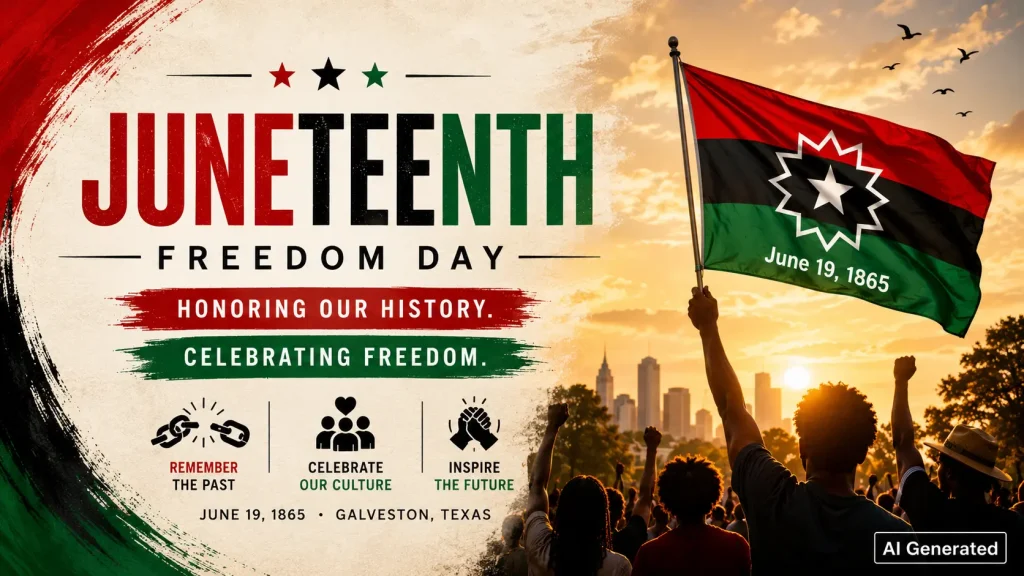
The Juneteenth flag features a white star representing Texas and a surrounding nova symbolizing new beginnings, with the date June 19, 1865 incorporated into its design.
The Juneteenth National Independence Day Act passed the U.S. Senate unanimously before President Biden signed it into law on June 17, 2021.
A Celebration of Freedom
Juneteenth survived a century and a half before it became a federal holiday not because institutions preserved it, but because communities did. The people who organized the first celebrations in 1866 were the same people who had just been told, 29 months late, that they were free. They chose to mark that date anyway — not with bitterness as the defining note, but with food, music, prayer, and the particular dignity of people who understood exactly what had been withheld and what it meant to finally have it.
That is what the holiday carries. Observing it is a way of standing in honest relation to American history — acknowledging what was promised, what was delayed, what was lost in that delay, and what was built despite it.
Frequently Asked Questions
What is Juneteenth and why is it a holiday?
Juneteenth is a federal holiday commemorating June 19, 1865 — the day Union troops arrived in Galveston, Texas and delivered word that slavery had ended to those who had been kept in the dark. It became a federal holiday in 2021 in recognition of its historical significance to American history and African American culture.
What happened on June 19, 1865?
Union Major General Gordon Granger read General Order No. 3 in Galveston, Texas, informing over 250,000 enslaved Black Texans of their freedom. This came more than two years after the Emancipation Proclamation had legally established that freedom — delayed because Confederate Texas had been beyond the reach of federal enforcement.
When did Juneteenth become a federal holiday?
President Biden signed the Juneteenth National Independence Day Act on June 17, 2021, making it the most recently established federal holiday in the United States.
Is Juneteenth still a federal holiday in 2026?
Yes. Juneteenth falls on Friday, June 19, 2026 and is fully recognized as a federal holiday.
What is the significance of Juneteenth?
Juneteenth marks the difference between freedom proclaimed and freedom enforced — a distinction with profound implications for how the United States understands its own history. Often called America’s second Independence Day, it acknowledges that the freedoms promised in 1776 were not extended to all Americans until decades later, and even then required military presence to take effect. It is also a celebration of Black culture, community, and the endurance of people who kept this history alive long before the country at large chose to recognize it.