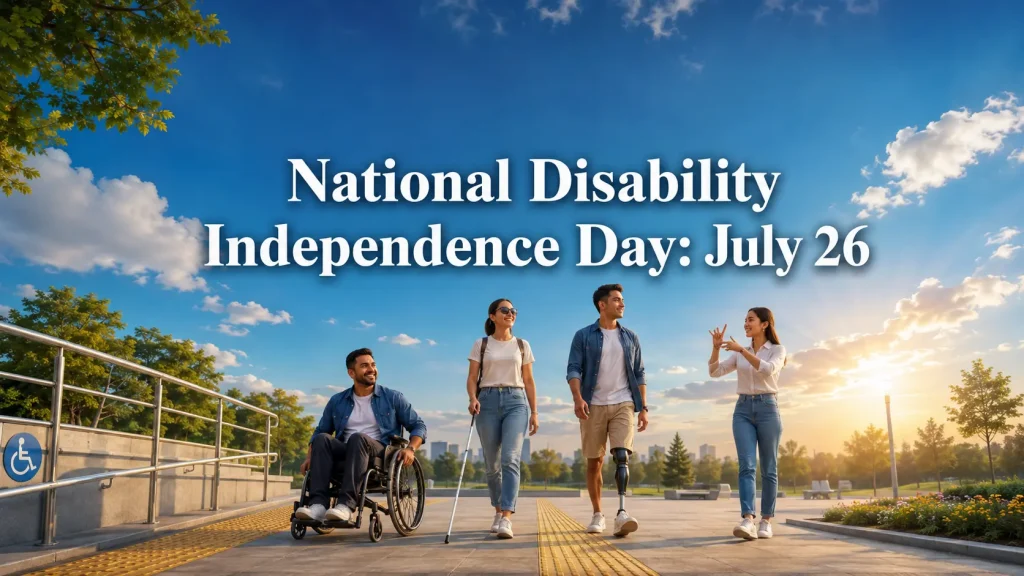


Most Americans can name the big civil rights milestones. But July 26 often gets overlooked — and it shouldn’t. National Disability Independence Day marks the anniversary of legislation that reshaped daily life for one in four Americans. Here’s the full story, the facts worth knowing, and ways to actually do something about it.
When Is National Disability Independence Day?
It falls on July 26, every single year — no floating Mondays, no three-day weekend shuffles. The date is locked to July 26, 1990, the day President George H.W. Bush signed the Americans with Disabilities Act into law.
It’s also worth knowing that all of July is recognized as Disability Pride Month across the U.S., making the end of the month a natural gathering point for events and advocacy.
National Disability Independence Day History
The disability rights movement didn’t start in 1990. Activists had been organizing since the 19th century, but things shifted significantly in the 1960s and 70s. The Rehabilitation Act of 1973 introduced Section 504 — the first federal law barring discrimination against disabled people in federally funded programs. It wasn’t enough, but it laid the groundwork.
Through the 1980s, disability advocates built coalitions, lobbied Congress, and staged demonstrations. Then came the moment that changed everything.
In March 1990, the ADA was stalling in Congress. Transit companies were lobbying hard against it, and lawmakers were dragging their feet. So more than 1,000 protesters marched to Washington. Over 60 of them left their wheelchairs and crutches at the bottom of the U.S. Capitol steps — and pulled themselves up all 83 stone stairs on their hands and knees.
Among them was Jennifer Keelan-Chaffins, an eight-year-old with cerebral palsy, who reportedly said, “I’ll take all night if I have to,” as she climbed. That image, now known as the Capitol Crawl, went across the country and gave lawmakers something they couldn’t ignore.
Four months later, Bush signed the ADA at a ceremony on the White House South Lawn, telling the crowd: “Every man, woman, and child with a disability can now pass through once-closed doors into a bright new era of equality, independence, and freedom.”
July 26 has been commemorated as National Disability Independence Day ever since.
National Disability Independence Day Facts
1 in 4 Americans has some form of disability, per the CDC — making the disability community one of the largest minority groups in the country.
The ADA passed with strong bipartisan support: 248 Democrats and 155 Republicans voted for it in the House. That kind of agreement on landmark civil rights legislation is nearly unheard of.
The law covers five areas: employment, state and local government, public accommodations, transportation, and telecommunications.
In 2008, the ADA Amendments Act broadened the definition of “disability” to protect more people, including those with episodic conditions like epilepsy.
In 2024, the Department of Justice finalized a rule requiring government websites and apps to meet digital accessibility standards — a reminder that barriers aren’t only physical.
The Disability Pride Flag, designed in 2019 by Ann Magill, uses colored stripes to represent different disability categories: red for physical, gold for neurodiversity, white for invisible conditions, blue for psychiatric and emotional, and green for sensory disabilities.
How to Celebrate National Disability Independence Day
You don’t need to attend a formal rally to make July 26 meaningful. Here are a few grounded ways to participate:
- Learn the actual history. Most people know the ADA exists; far fewer know about the Capitol Crawl, Jennifer Keelan-Chaffins, or Senator Tom Harkin delivering part of his ADA floor speech in sign language so his deaf brother could understand. Read up, then share what you find.
- Check your own accessibility. If you run a business, manage a website, or oversee a physical space, July 26 is a useful prompt to honestly evaluate how accessible you actually are. Use the hashtag #DisabilityIndependenceDay to engage the conversation online.
- Amplify disabled voices. Follow, read, and share the work of disabled writers, artists, and advocates — not just today but consistently. The spirit of the ADA isn’t a one-day thing.
- Support organizations doing the work. Local Centers for Independent Living, the American Association of People with Disabilities (AAPD), and other disability-focused nonprofits can use both donations and volunteers year-round.
The Day Still Has Work to Do
Over 35 years after that South Lawn signing, gaps remain. Employment rates for people with disabilities still lag. Digital inaccessibility shuts people out of services and information every day. Physical barriers haven’t all come down.
The activists who crawled up those Capitol steps weren’t asking for sympathy. They were demanding the same access every American is supposed to have. National Disability Independence Day is worth marking precisely because that demand hasn’t been fully met — and because the history behind it is too important to forget.
Frequently Asked Questions
When was the Americans with Disabilities Act passed?
The ADA was signed into law on July 26, 1990, by President George H.W. Bush. The bill was first introduced in Congress in April 1988 by Senators Tom Harkin and Lowell Weicker.
What is the Americans with Disabilities Act?
The ADA is a federal civil rights law that prohibits discrimination against people with disabilities across most areas of public life — jobs, schools, transportation, government services, and public places like restaurants and hotels. It also requires employers to provide reasonable accommodations and mandates that public spaces meet accessibility standards. Think of it as the disability community’s equivalent of the Civil Rights Act of 1964.
When did the Americans with Disabilities Act become law?
It became law on July 26, 1990. Most provisions took effect in phases — larger employers were covered by 1992, smaller ones by 1994. The law was later strengthened by the ADA Amendments Act, signed in 2008 and effective January 1, 2009.