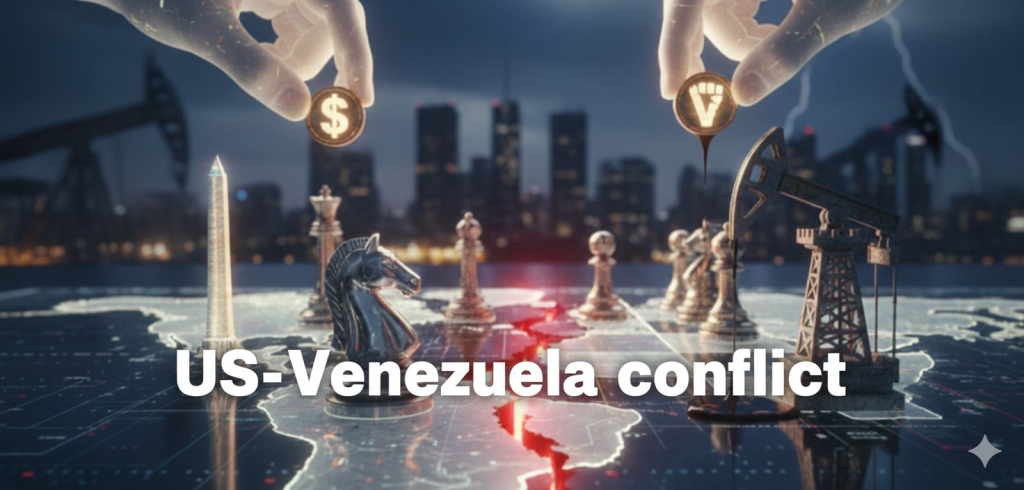


The US-Venezuela conflict has been one of the most significant geopolitical struggles in the Western Hemisphere for over two decades. What began as an uneasy diplomatic coexistence has evolved into a period of outright political and economic confrontation. To understand the current state of affairs, one must delve into the historical roots, the ideological shifts, and the profound humanitarian impact of this enduring standoff.
The Roots of the US-Venezuela Conflict: Oil and Ideology
Historically, the relationship between these two nations was built on a complex interdependence centered on energy. Venezuela, home to the world’s largest proven oil reserves, was a primary supplier to the United States for much of the 20th century.
However, the dynamic of the US-Venezuela conflict shifted dramatically in 1999 with the rise of Hugo Chávez.
-
The Bolivarian Revolution: Chávez championed a socialist movement that prioritized nationalizing key industries and land redistribution.
-
Ideological Clashes: Chávez openly challenged U.S. influence in Latin America, leading to increased friction with Washington.
-
U.S. Concerns: Washington viewed the “Bolivarian” agenda and Chávez’s ties with global adversaries as a threat to regional stability.
The Maduro Era: Escalation and Economic Decline
Following the death of Chávez in 2013, the US-Venezuela conflict entered a more volatile phase under Nicolás Maduro. The combination of falling global oil prices and internal economic mismanagement led to a catastrophic decline in the Venezuelan economy.
Key Factors in the Escalation:
-
Humanitarian Emergency: The economic collapse triggered severe shortages of food and medicine, resulting in one of the largest migration crises in history.
-
Economic Sanctions: In response to alleged human rights abuses and democratic backsliding, the U.S. implemented rigorous sanctions targeting the state oil company (PDVSA) and government officials.
-
Political Stand-off: Tensions peaked in 2019 when the U.S. and several allies recognized an interim presidency, further isolating the Maduro government.
Core Contention Points in the US-Venezuela Conflict
To grasp the depth of this struggle, four primary areas of contention must be considered:
| Point of Contention | U.S. Perspective | Venezuelan Government Perspective |
|---|---|---|
| Governance | Views the regime as authoritarian and undemocratic. | Accuses the U.S. of imperialistic interference and coup attempts. |
| Economy | Attributes collapse to corruption and mismanagement. | Blames “economic war” and foreign sanctions for the crisis. |
| Oil Strategy | Seeks regional energy security and market stability. | Views oil as a tool for national sovereignty and social funding. |
| Security | Concerned about ties with non-democratic actors. | Asserts the right to form independent global alliances. |
The Path Forward: What’s Next?
As of 2026, the US-Venezuela conflict remains a complex quagmire with no simple resolution. While there have been sporadic efforts at dialogue, both sides remain entrenched.
Intellectual and diplomatic circles suggest that the future hinges on a delicate balance:
-
Sanctions Relief: Possible easing of restrictions in exchange for verified democratic reforms.
-
International Pressure: Ongoing calls from neighboring countries for a peaceful, humanitarian-led transition.
Understanding the intricacies of the US-Venezuela conflict is crucial for anyone seeking to grasp the modern geopolitical landscape of the Americas.