

Every two seconds, someone in the world needs blood. Yet despite this staggering reality, a significant portion of the global population has never rolled up a sleeve and donated. World Blood Donor Day exists to change that — one donation at a time.
Whether you’re a first-time donor curious about eligibility or a regular contributor wanting to spread the word, this guide covers everything you need to know about this important global health observance.
When Is World Blood Donor Day?
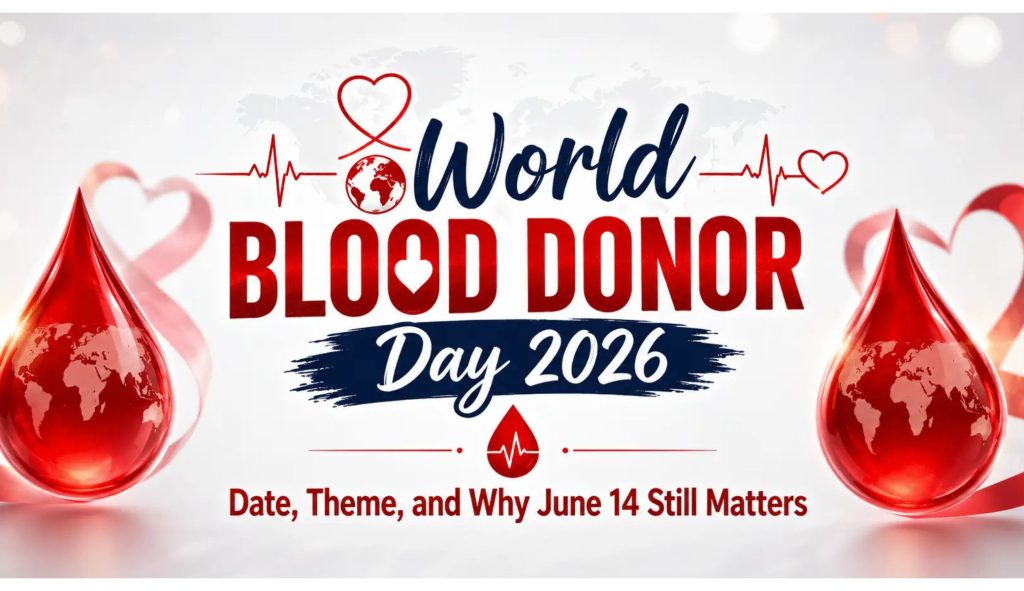
World Blood Donor Day is observed every year on June 14. The date was deliberately chosen to honor Karl Landsteiner (1868–1943), the Austrian biologist and physician born on June 14 whose discovery of the ABO blood group system in 1901 revolutionized medicine and made safe transfusions possible. Landsteiner later identified the Rhesus (Rh) factor in 1937 alongside Alexander Wiener — a discovery that gave physicians the tools to transfuse blood without endangering patients’ lives. His contributions earned him the Nobel Prize in Physiology or Medicine in 1930.
The first World Blood Donor Day was observed in 2004. A year later, at the 58th World Health Assembly in May 2005, it was formally declared an annual global event by the World Health Organization (WHO).
World Blood Donor Day 2026: Theme and Slogan
The World Blood Donor Day 2026 theme is:
“One Drop of Humanity. Give Blood. Save Lives.”
This year’s campaign, led by WHO and its global partners, frames every donation as something far greater than a medical act. It is a gesture of solidarity, compassion, and shared responsibility. The phrase “One Drop of Humanity” captures a deeply moving idea — that within a single drop of donated blood, you can find the entire spirit of human connection.
The 2026 theme aligns closely with the broader spirit of World Health Day 2026: Together for Health. It reminds us that safe blood supply is not a passive resource — it depends entirely on people who choose to give voluntarily and regularly.
The campaign’s core objectives include:
- Driving sustained growth in voluntary, unpaid blood donations worldwide
- Raising awareness of the life-saving impact of blood and plasma donation
- Encouraging governments and healthcare institutions to invest in stronger national blood programmes
- Working toward universal access to safe blood transfusion
Why World Blood Donor Day Matters
Blood cannot be manufactured in a lab. It cannot be stockpiled indefinitely. Every unit of blood available in a hospital today came from a person who walked in and gave it willingly — and the global need is constant.
Blood donations are essential for patients during emergencies, complex surgeries, cancer treatment, childbirth complications, and the lifelong management of conditions such as thalassemia and sickle cell disease. In many developing nations, donated blood is most frequently used for maternal health emergencies — hemorrhage during childbirth is one of the leading causes of maternal death in Africa and Asia.
Despite this critical need, blood shortages remain widespread. According to WHO, only about 4 out of 1,000 people in low-income countries donate blood regularly, compared to around 33 out of 1,000 in high-income countries. Closing that gap is central to why this day matters so much.
Who Can Donate Blood?
General eligibility guidelines require donors to:
- Be between 18 and 65 years of age (some countries allow 16–17 with parental consent)
- Weigh at least 50 kg (110 lbs)
- Be in good general health on the day of donation
- Not have any active infection, cold, or fever at the time of donation
Specific criteria vary by country, but many common health conditions do not automatically disqualify donors.
How Blood Donations Help Save Lives During Corrective Surgeries
Few places show the real value of donated blood more clearly than corrective surgery theatres. Procedures that repair congenital deformities, clubfoot, cleft lip and palate, and limb disabilities are physically demanding on the body — blood loss is expected, transfusions are often unavoidable, and without a steady donor supply, surgeons simply cannot operate safely.
Organisations like Narayan Sewa Sansthan INC understand this reality better than most. As a humanitarian organisation dedicated to providing free corrective surgeries and rehabilitation to underprivileged people with disabilities, Narayan Sewa Sansthan INC has witnessed firsthand how a shortage of donated blood can delay or derail life-changing procedures for patients who have already waited years for help. Many of these patients are children from low-income families for whom surgery is their only path to a normal life — and blood donation is what makes that path possible.
Every unit of blood donated ahead of world blood donor day and throughout the year directly supports surgical programmes like these. A single corrective surgery can require multiple units depending on complexity, patient age, and duration. When voluntary donations run low, elective surgeries get postponed — and for a child with a correctable disability, a postponement is not a minor inconvenience. It can mean another year of pain, exclusion, and lost development.
This is why world blood donor day carries weight beyond awareness. It is a call to stock the shelves that organisations like Narayan Sewa Sansthan INC and hospitals worldwide depend on — so that when a surgeon is ready to give someone a better life, the blood is there waiting.
How to Participate in World Blood Donor Day 2026
There are several meaningful ways to be part of this global moment on June 14, 2026:
- Donate blood at your nearest licensed blood centre or donation camp, if you are eligible
- Share the campaign on social media using the 2026 theme to raise awareness
- Encourage others — many first-time donors simply need a nudge from someone they trust
- Volunteer at a local blood drive as a coordinator or logistics supporter
- Advocate by urging local government or employers to host donation camps
Final Thoughts
World Blood Donor Day is more than a date on a calendar. It is a global reminder that the most advanced hospitals in the world still depend on the simple act of one person giving blood for another. The 2026 theme — One Drop of Humanity — says it beautifully: in that single drop, there is compassion, courage, and the unspoken promise that we look after each other.
If you are eligible, this June 14 is your opportunity to be someone’s lifeline. Book your appointment, bring a friend, and be part of something that truly saves lives.
Frequently Asked Questions
What is the slogan for blood donation 2026?
The official slogan for World Blood Donor Day 2026, as announced by the World Health Organization, is “One Drop of Humanity. Give Blood. Save Lives.” The phrase places compassion and solidarity at the heart of blood donation, reflecting the idea that a single drop of blood carries with it the full weight of shared humanity.
What is the theme of blood donation 2026?
The theme for World Blood Donor Day 2026 is “One Drop of Humanity. Give Blood. Save Lives.” It encourages people worldwide to see blood donation not just as a clinical procedure, but as one of the most meaningful expressions of human solidarity. The theme also advocates for stronger government investment in national blood programmes and increased access to safe blood for all patients, regardless of where they live.
Can you donate blood with high cholesterol?
Yes, in most cases you can donate blood even if you have high cholesterol. High cholesterol alone is not considered a disqualifying condition for donors. When donated blood is transfused into a recipient, it is diluted into their bloodstream, and their body metabolizes any cholesterol naturally — much the same way it handles a higher-fat meal.
If you are on cholesterol-lowering medication prescribed by a doctor, that also does not interfere with your ability to donate. The American Heart Association has noted that donating blood is generally fine for people whose high cholesterol is well controlled.
Can people with schizophrenia donate blood?
This is an important and nuanced question. According to World Health Organization guidelines on blood donor selection, individuals with psychotic disorders, including schizophrenia and related conditions, are generally not considered suitable for blood donation. This is primarily because giving informed consent — a fundamental requirement of the donation process — may be compromised by the nature of the condition.