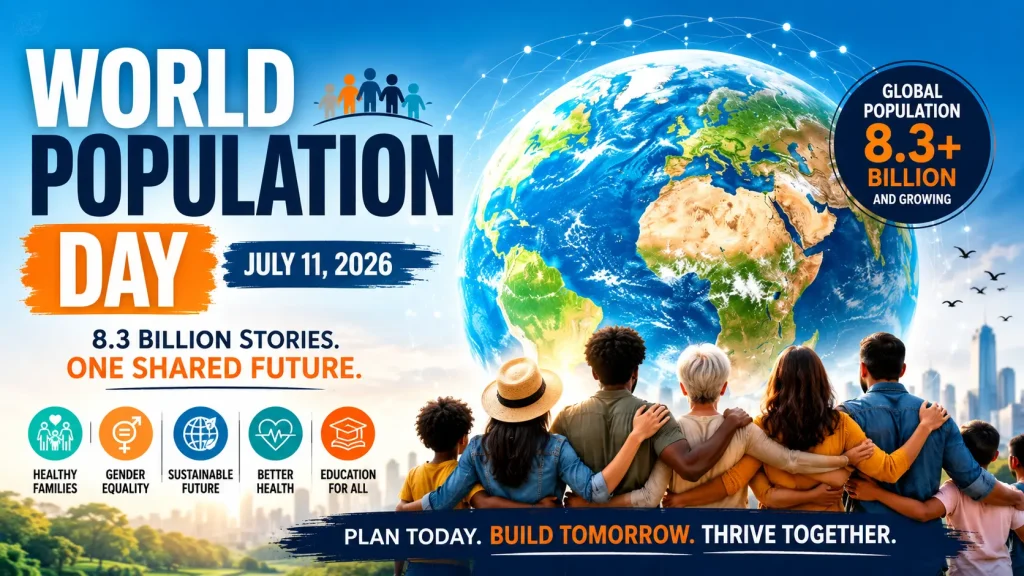


World Population Day falls on July 11 each year. It is a United Nations observance that draws attention to global population issues, and in 2026, with the world’s population above 8.3 billion, the topic carries real weight. Many Americans assume population growth is a distant issue, something happening in other countries. The data says otherwise. Population trends affect food prices, labor markets, immigration policy, and the economy your children will work in.
Consider one figure from UNFPA’s most recent State of World Population report: across a 14-country survey covering more than a third of the global population, 18% of adults of reproductive age said they expect to end up with fewer or more children than they actually want. The barriers cited most often were the cost of raising a child, job insecurity, and the price of housing — not a lack of desire to become parents. That single statistic captures what this article is really about: population numbers are not abstract. They are the sum of millions of individual decisions, shaped by economics, healthcare access, and policy.
This blog covers what World Population Day is, where it came from, and why the data behind it still matters to American readers.
What Is World Population Day
World Population Day is observed annually on July 11. The UN created it to focus public attention on population-related issues: family planning, maternal health, gender equality, and sustainable development. It carries no federal holiday status in the United States, so offices and schools stay open as usual. Health organizations, nonprofits, and educators use the date as a recurring hook for conversations that don’t usually get airtime.
The goal here is not to celebrate population growth for its own sake. Think of the day more as a checkpoint, a moment built into the calendar to ask what rising or falling populations mean for healthcare systems, water supplies, housing, and reproductive rights.
July 11 World Population Day: Why This Date
The choice of July 11 traces back to one specific event, not an arbitrary date on the calendar.
History of World Population Day
In 1987, demographers estimated that the global population had crossed five billion people. The date was marked informally as “Five Billion Day,” and it generated more public interest than officials expected. Newspapers covered it. People talked about it. That reaction caught the attention of the United Nations Development Programme (UNDP).
Two years later, in 1989, the UNDP’s Governing Council formally established World Population Day, setting the date on July 11 to mark the anniversary of that five-billion milestone. The intent was to convert a one-time news cycle into a recurring platform for action on family planning, gender equality, and public health.
Since 1989, the United Nations Population Fund (UNFPA) has led most of the coordination, working with governments, schools, and advocacy groups on seminars, campaigns, and fundraising tied to the date.
World Population Day Theme 2026
The UN assigns a theme to World Population Day each year to direct attention toward one issue. Recent themes have addressed gender equality, the needs of teenage girls, and, in 2025, the barriers young people face when trying to build the families they want.
At the time of writing, the UN has not released an official theme for World Population Day 2026. Based on the pattern of recent years, the theme will likely center on reproductive rights, youth empowerment, or the growing split between countries with rapid population growth and countries facing decline. Once the UN confirms the theme, check UNFPA’s official site for the announcement and the campaign materials that follow.
Does the World Population Increase Each Day?
Yes. Even though the rate of growth has slowed substantially since the 1960s, the global population still grows by roughly 200,000 to 220,000 people per day, net of births and deaths. Put another way, the world adds the population of a mid-sized American city every 24 hours.
Over a longer stretch, the world gains approximately 100 million people about every 14 months. That pace is why crossing a new billion-person threshold still makes international news. The most recent milestone came on November 15, 2022, when the global population passed 8 billion.
Growth is not distributed evenly. Japan, South Korea, China, and much of Europe are seeing population decline as birth rates fall below replacement level. Sub-Saharan Africa, by contrast, continues to grow quickly, with several countries in the region still recording fertility rates above 4 children per woman. The scale of the global shift is worth noting on its own: the average global fertility rate stood at nearly 5 children per woman in 1970. By 2025, the global average had fallen well below that, with many large countries, including India, now sitting under the replacement level of 2.1 children per woman. India’s rate dropped to 1.9 in 2025, a marker of how fast demographic transitions can move even in countries with very large populations.
This decline is not happening because fewer people want children. The UNFPA survey referenced earlier found that financial limitations, unemployment, and housing costs were the leading reasons people end up having fewer children than they originally wanted. A separate UNFPA report on the maternal health workforce found a global shortfall of 1.1 million reproductive, maternal, newborn, and adolescent health workers, with midwives accounting for roughly 900,000 of that gap. So even in places where people do want children and want to raise them safely, the healthcare staff to support that choice is often missing. That gap, between aging, shrinking populations in some regions and young, expanding ones in others, is one of the defining demographic stories of the decade.
How to Celebrate World Population Day
A few practical ways to mark the day include:
- Read current data through UNFPA’s World Population Dashboard and share key facts using #WorldPopulationDay.
- Donate to or volunteer with organizations focused on reproductive health, such as Planned Parenthood, Population Connection, or UNFPA.
- Attend or organize discussions at schools, libraries, or community centers about sustainability or global health.
- Talk with students or younger family members about immigration, environmental sustainability, and economic opportunity.
- Support local sustainability efforts, including water conservation and waste reduction.
The point of the day is awareness and a small, practical contribution—not a grand gesture.
The Bottom Line
The number behind World Population Day matters less than what it represents. Each digit in 8.3 billion is an individual life shaped by access to healthcare, education, and opportunity. For American readers, the practical takeaway is that demographic shifts overseas, aging populations in East Asia, rapid growth across parts of Africa, changing migration patterns, eventually show up at home, in trade flows, labor markets, and the price tag on everyday goods.
This July 11 is a reasonable moment to look past the headline figure. The people behind it, and the choices they’re able or unable to make about their own families, are where the real story sits.
Frequently Asked Questions
When did Earth hit 1 billion?
Demographers estimate the global population first reached 1 billion around 1804. It took most of human history to get there, then roughly 200 years to multiply that figure eightfold.
Who was the father of World Population Day?
No single person is credited as the founder, though Dr. K.C. Zachariah, a senior demographer at the World Bank, is often named as the one who proposed marking the date the population reached five billion. His suggestion, combined with the public attention around “Five Billion Day” in 1987, led the UNDP to establish the observance in 1989.
What country has the highest population in the world in 2026?
India holds the top position in 2026, with an estimated population between 1.46 and 1.48 billion, having overtaken China in 2023. China is now second, at roughly 1.41 billion, with its population in gradual decline due to low birth rates. The United States ranks third, with a population near 345 to 350 million.
What is 90% of the world’s population?
With the global population at approximately 8.3 billion in 2026, 90% of that total comes to roughly 7.47 billion people. This figure is often cited in discussions about resource access, such as how many people worldwide lack reliable clean water or consistent healthcare.
How many humans will be alive in 2050?
The United Nations projects the global population will reach approximately 9.7 billion by 2050. Growth is expected to continue slowing after that point, with most projections placing the eventual peak somewhere between 10.3 and 10.9 billion in the 2080s, followed by a gradual decline.