

Giving money to a good cause should feel great, but in 2026, it often feels a bit like a gamble. With social media ads and “urgent” emails flying around, the first question on any donor’s mind is: how to know if a charity is legit? While the vast majority of organizations in the USA are doing incredible work, a few bad actors make it hard for everyone.
Learning how to check if a non profit is legitimate is the only way to make sure your hard-earned cash actually helps someone instead of just paying for a scammer’s new car. This guide is a deep dive into how to spot the fakes and find the heroes.
How to Check if a Charity Is Legit (Quick Checklist)
If you are standing in line or scrolling through your phone and need to know how to check if a non profit is legitimate right now, use this “Five-Minute Filter”:
- Spot the EIN: Every real USA charities has a 9-digit Tax ID (Employer Identification Number). If they won’t give it to you, walk away.
- Use the IRS Portal: Go to the official “Tax Exempt Organization Search” (TEOS) on the IRS website. If they aren’t there, they aren’t a legal 501(c)(3).
- The “Scam” Search: Type the charity’s name into Google followed by the word “scam” or “complaint.”
- Look for a Map Pin: Does the charity have a real office? A P.O. Box is fine for mail, but a legit group needs a physical headquarters.
- Demand Data: Real charities show photos of their actual work—not just generic stock photos of people smiling.
Using these steps is the fastest way to find out if a charity is legit before you hit that “Donate” button.
How to Check Out a Charity Before You DONATE?
Once you know they are legal, you have to figure out if they are actually good at what they do. A deep charity evaluation is about more than just a tax status; it’s about efficiency. When you are learning how to check if a non profit is legitimate, you have to look at their “Program Ratio.”
Cracking Open the Form 990
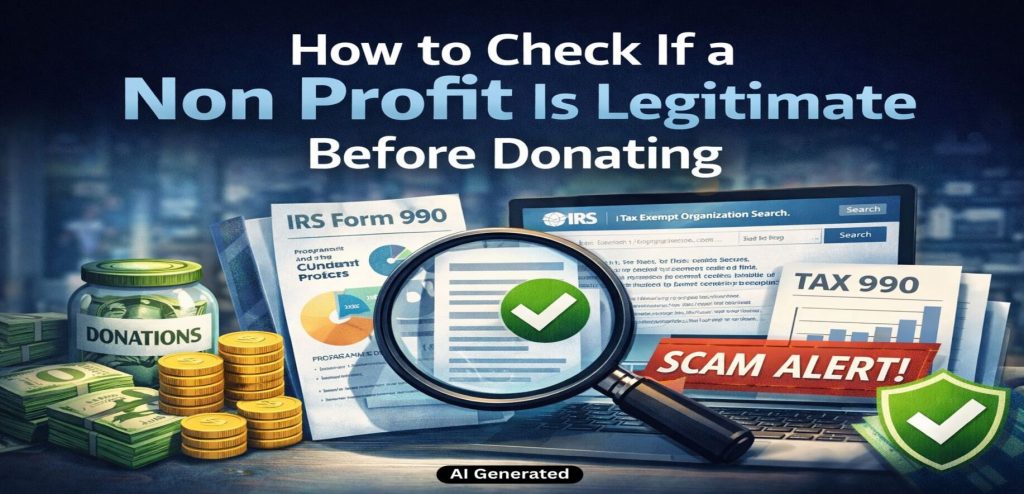
To really see how to check if a non profit is legitimate, you need to look at their IRS Form 990. This is a public tax return that shows exactly how much the CEO gets paid and how much goes to the actual cause. You can find these for free on ProPublica’s Nonprofit Explorer. If the “Fundraising” slice of their pie chart is bigger than the “Program” slice, they are basically a marketing firm disguised as a charity.
The 2026 Transparency Bar
In today’s world, a simple brochure isn’t enough. When you evaluate a charity, look for:
- Specific Numbers: Did they feed 100 people or 10,000?
- Watchdog Ratings: Check Charity Navigator or Candid (GuideStar). If they have a “Platinum Seal of Transparency,” they are usually the real deal.
- Fresh Updates: If their last “Impact Report” is from 2021, something is wrong.
How to Vet Charities Like a Smart Donor
Vetting is about looking under the hood. If you want to know how to check if a non profit is legitimate, you need to check their “Governance.” This is a fancy word for who is in charge.
Who is on the Board?
A major part of knowing how to check if a non profit is legitimate is looking at the Board of Directors. A healthy nonprofit should have at least five independent people who aren’t related to the CEO. If the board is just the CEO’s family, there is nobody there to say “no” to bad spending.
Long-Term Solutions
When you vet charities, look for groups that solve problems, not just cover them up. A charity that gives away shoes is great, but a charity that teaches people how to make shoes is even better. This level of thinking is a hallmark of a deeply vetted organization.
How to Avoid Charity Scams (Red Flags)
Scammers love to use big emotions to shut down your brain. To stay safe in the USA, you must know how to avoid charity scams by watching out for these tricks:
- The “Rush” Job: If someone tells you that you must give right this second, it’s probably a scam. Real charities don’t mind if you take a day to think.
- Gift Card Requests: No real charity will ever ask you to pay with a Target gift card, a wire transfer, or Bitcoin. This is a 100% sign of a scam.
- The “Thank You” Trap: Some scammers send a “Thank you for your $50 gift last year” email, even if you never gave. They hope you’ll feel bad and send money now.
- Copycat Names: Watch out for “The Cancer Fund of America” when you meant “The American Cancer Society.”
Knowing how to check if a non profit is legitimate means reading the fine print and double-checking the spelling of the name.
Real Example: How to Check Out a Charity Before You Donate
Imagine you see a post about helping a village get clean water. To check out a charity before you donate, don’t just click the link in the bio. Go to their website. Check for an EIN. Look for a 2025 or 2026 financial report. Call their office. If nobody picks up or the address is a parking lot, you just saved yourself from a scam. This is exactly how to check if a non profit is legitimate in the real world.
Support a Transparent Cause
If you want an organization that makes a real impact, check out Narayan Sewa Sansthan. It’s a fully registered 501(c)(3) that focuses on the “forgotten” members of society. It provides free surgeries for people with physical disabilities and even gives them artificial limbs or other mobility aids and job training.
Everything this Charity does is open for you to see. It has helped over 460,000 people over 40 years, and they are one of the most transparent groups out there.
Make a real impact. If you want your money to go directly to helping a child walk again, donate online to Narayan Sewa Sansthan. You’ll know exactly where your gift goes, and you’ll be part of a mission that changes lives for good.
FAQs
1. How can I verify a 501c3?
The only way to be 100% sure is the IRS Tax Exempt Organization Search. It’s the official government list of who is real and who isn’t.
2. How to check out a charity before you donate online?
Look for the little padlock icon in the URL bar, check for a physical street address, and make sure their “Privacy Policy” says they won’t sell your email to other people.
3. How to check if a non profit is legitimate through their staff?
Look them up on LinkedIn. If the “CEO” has no history of charity work or seems like a fake profile, move on to a different organization.
4. What is the 50 30 20 rule for charities?
It’s a guideline: at least 70% of money should go to the cause, while the rest can go to running the office and finding new donors.